Cuicuilco Archaeological Site and Museum
A museum, one of the only round pyramids in the country, and a history as deep as it is broad, Cuicuilco is not a site to be missed.
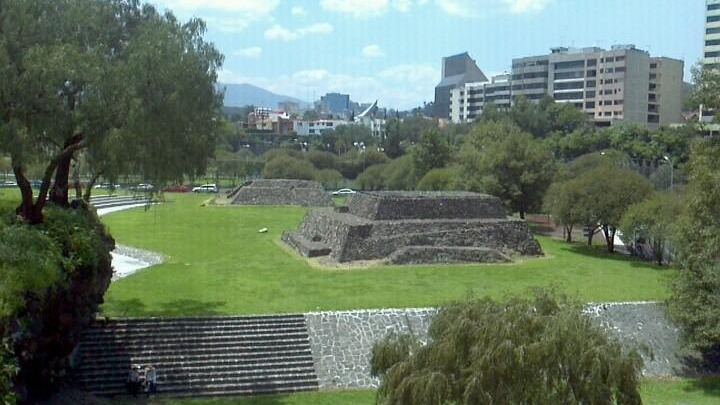
Cuicuilco was the first ceremonial center in the Valley of Mexico. The word Cuicuilco comes from Nahuatl and means “place of songs.” Recent research indicates that it was inhabited as early as 2000 BCE, reaching its peak during the Middle Preclassic period, between 600 and 800 CE. The city may have had up to 20,000 inhabitants.
The eruptions of the Xitle volcano between 245 and 315 CE forced the site to be abandoned, as it was buried under lava. This migration played a decisive role in the later development of cultures such as the Teotihuacan civilization. The lava-covered area is now known as El Pedregal de San Ángel, which includes much of the Ciudad Universitaria campus, as well as neighborhoods like El Pedregal and Romero de Terreros, extending all the way to the foothills of the Ajusco mountain.
The main structure is dedicated to the god Huehuetéotl, the “Old God of Fire,” and inside, red cinnabar drawings can be found. Some studies suggest that this was one of the places where the first steps were taken toward developing a calendar based on the observation of the sun’s movements.
The site is divided into Cuicuilco A — which includes the Great Platform, the Kiva, Building E1, and the Stele — as well as an ecological reserve. There are also three additional sectors outside the main archaeological zone: Cuicuilco B (Villa Olímpica), Peña Pobre, and Cuicuilco D, which includes the Tenantongo mound in the Bosque de Tlalpan.
The museum highlights the importance of one of the oldest cities in the Valley of Mexico and the first major civic-religious center of the Mexican Highlands. It opened in 1970 and displays artifacts unearthed during excavations, such as tools, personal objects, and even human remains that reveal aspects of the ancient inhabitants’ customs.
The archaeological site is located at the intersection of Insurgentes Avenue and the Periférico ring road, across from the Perisur shopping mall. Admission includes access to the museum, parking, and restrooms.
Hours: Monday to Sunday, 9:00 a.m. to 5:00 p.m.






-(1)-(1).png)