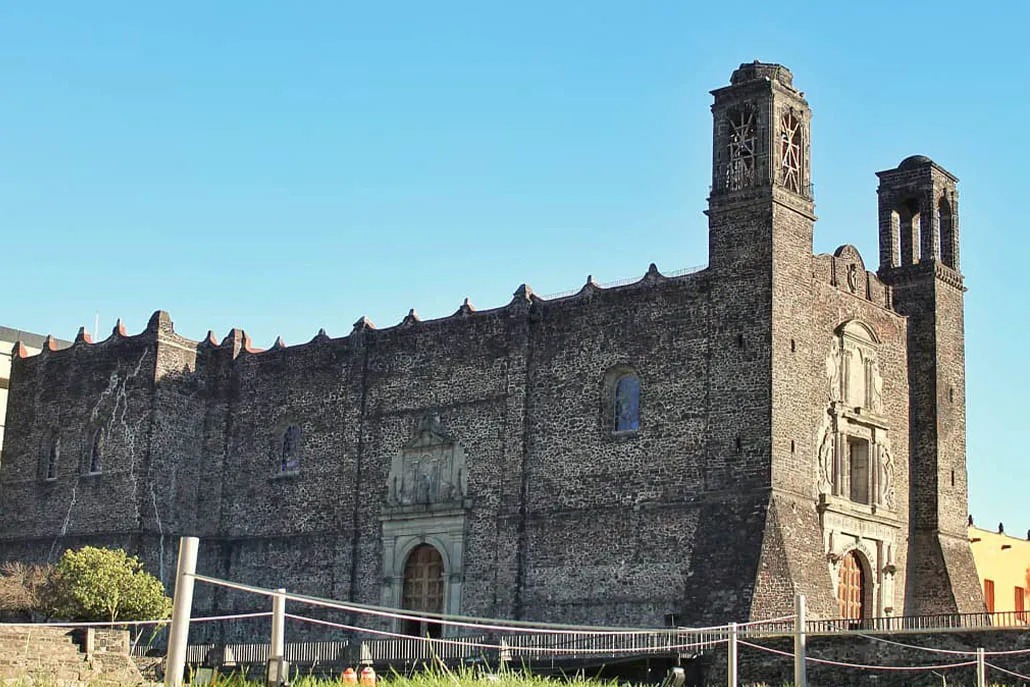
Church of Santiago Tlatelolco
Among the oldest colonial buildings in the city, this one stands out for sheer austerity.
TheChurch of Santiago Tlatelolco, located in Mexico City, was originally the temple of the great College of the Holy Cross of Tlatelolco. It is mentioned separately because, for many years, it has functioned as an independent Catholic parish. Often mistaken for the old university complex, the church stands as the most striking presence in the Plaza de las Tres Culturas. Among the three eras represented in the plaza, the church shines as a symbol of Mexico’s colonial heritage. Its history is deeply intertwined with that of the College, located to the south and west of the current temple.
Construction began shortly after the fall of Tenochtitlan in 1521. It is said that the Spaniards chose this very spot because Mexica warriors had fiercely resisted the conquest here for nearly 80 days. The site also held profound ceremonial and spiritual importance for the people of Tlatelolco.
Santiago Tlatelolco stands as a remarkable example of the Spanish effort to impose a new culture over the old. The church was built using stones from pre-Hispanic temples, and to this day, a fragment of an ancient deity associated with agriculture can still be seen on its eastern side. Saint James the Great, patron saint of Spain, was a symbol of the Christian struggle during the Reconquista. According to legend, he reappeared asSantiago Matamoros, embodying the victory and faith that accompanied Spain’s expansion into the New World.
The Temple of Santiago
The temple we see today was built by the Franciscans and completed in 1609 under the direction of Friar Juan de Torquemada. That same year, three altarpieces were installed inside. By the 18th century, the church was filled with ornate altarpieces, which were later redone in 1763. In 1861, the temple ceased to function as a Catholic church, and much of its interior decoration was lost. It was finally restored and reopened to the public in 1964.
Today, the Church of Santiago Tlatelolco, in Mexico City, stands as a powerful—and sometimes somber—symbol of Spanish colonization and the cultural transformation of the Americas. To fully grasp its legacy, it’s worth exploring the College of the Holy Cross, whose educational and cultural influence remains vital to this day. The Plaza de las Tres Cultura sitself offers a fascinating journey through the layered history of Mexico City.








-(1)-(1).png)


_gmxdot_jpeg)
_gmxdot_jpeg)